
Workplace safety for the operations behind the fleet
Terminals, docks, maintenance shops and warehouses carry their own OSHA exposure. So do plants, distribution centers and contractor yards. We assess the exposure, score it and write it up so leadership, insurers and auditors can follow it.
What we do
- OSHA Gap Audit
- OSHA 300 Log & Recordkeeping Review
- Mock OSHA Inspection
- Heat Illness Program Review
- Incident Investigation & Root Cause
- Written Safety Programs — Site-specific written programs where the operation needs them: hazard communication, energy control (lockout/tagout), powered industrial truck training and evaluation records, emergency action and fire prevention plans where a standard requires them, and the PPE hazard assessment. Built from how the site runs, not from a template.
Who it's for
Fleets and 3PLs with terminals, cross-docks, shops or warehouses. Manufacturers and distributors. Contractors with yards and shops. Shippers with docks and loading areas. Insurers, captives, brokers and TPAs that need field proof on the operations they cover.
Why Zorro
- Findings framed for cost, operations and insurance, not only for compliance.
- One firm for the truck and the dock: fleet and facility findings in the same scored format.
- Dated, sourced, defensible: every finding tied to the standard it rests on (29 CFR 1904/1910 citations).
How it fits with free state consultation
Every state, including Tennessee through TOSHA, offers free, confidential on-site consultation for small and medium-sized businesses; it issues no citations or penalties, and employers agree to correct serious hazards. We work alongside that: our reports are built for insurers, boards and counsel, and we can help you prepare for or follow up on a consultation visit.
FAQ
Do you only do trucking?
No. Fleet and DOT work is our core. We also cover OSHA general-industry exposure for any business that needs it: warehouses, plants, shops, docks and yards.
Will this make us OSHA compliant?
No firm can promise that. We identify gaps against the cited standards and give you a prioritized plan; closing them is your operation's work, and we can track it.
Are you affiliated with OSHA?
No. Zorro is an independent private firm. We are not affiliated with or endorsed by OSHA or any state plan.
Do you issue OSHA 10/30 cards?
No. Zorro is not an OSHA-authorized trainer. OSHA 10- and 30-hour classes are taught through OSHA's Outreach Training Program by OSHA-authorized trainers, who issue the course completion cards. We can point you to OSHA's trainer finder.
Does federal OSHA apply in our state?
Some states, including Tennessee, run their own state OSHA plans, which must be at least as effective as federal OSHA and can differ from it. We scope to the plan that covers each site.
Is AI used?
Yes. We use AI-assisted analysis.
OSHA Gap Audit for terminals, docks, shops and warehouses
A site walk and document review that scores one facility against the OSHA standards most often cited in general industry, reported in a form your leadership and your insurer can both use.
Why these areas: Hazard communication, lockout/tagout, respiratory protection, powered industrial trucks and machine guarding all appear on OSHA's preliminary list of the most frequently cited standards for fiscal year 2026 (https://www.osha.gov/top10citedstandards).
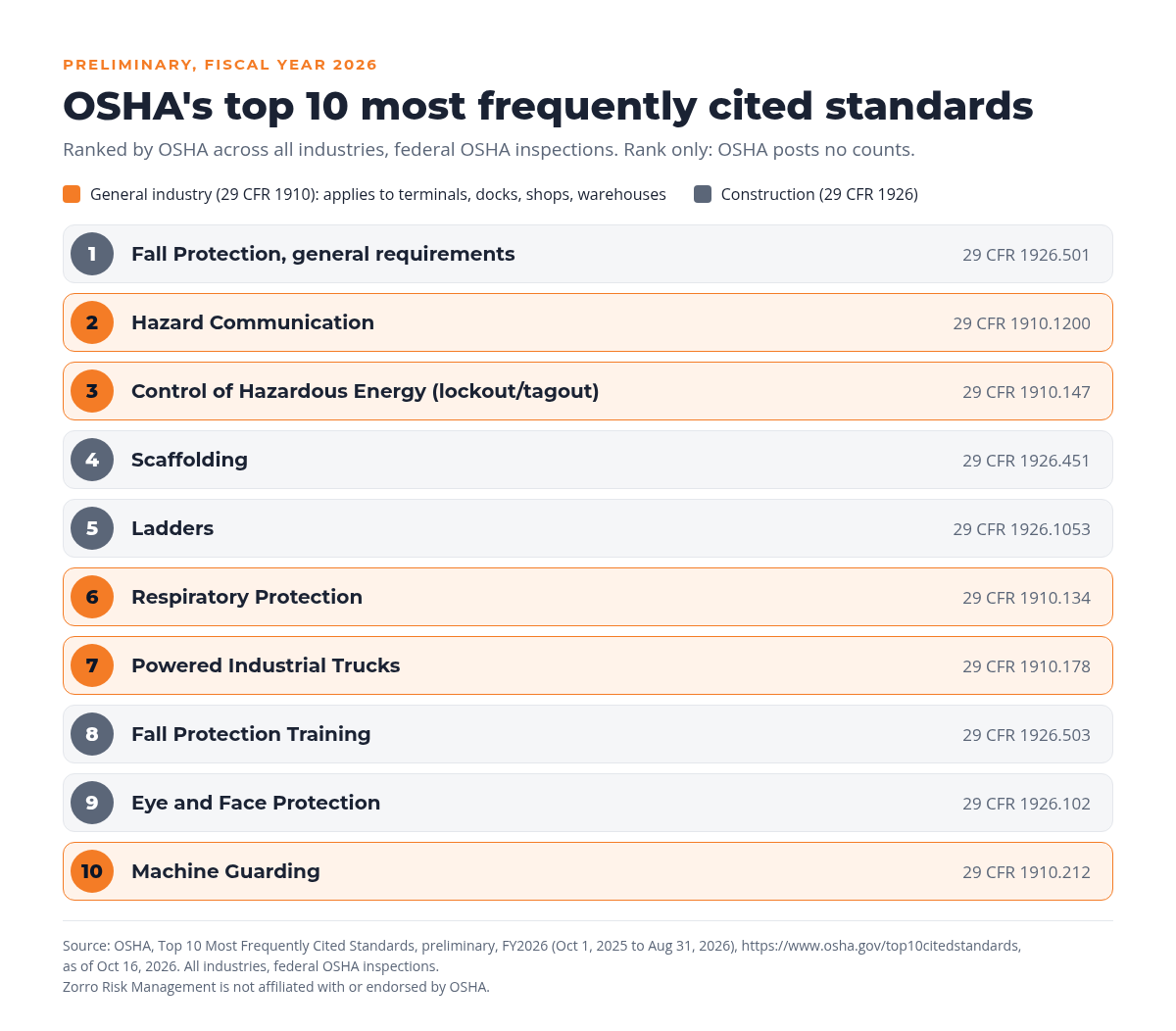
Preliminary, fiscal year 2026
OSHA's top 10 most frequently cited standards
Ranked by OSHA across all industries, federal OSHA inspections. Rank only: OSHA posts no counts.
Zorro Risk Management is not affiliated with or endorsed by OSHA.
What we score:
| Area | Standard | What we look at |
|---|---|---|
| Hazard communication | 29 CFR 1910.1200 | Written program, chemical inventory, safety data sheet access, container labels, training records |
| Energy control (lockout/tagout) | 29 CFR 1910.147 | Energy control program with documented machine-specific procedures, periodic inspections at least annually, and training for authorized, affected and other employees |
| Powered industrial trucks (forklifts) | 29 CFR 1910.178 | Operator training, evaluations at least every three years, daily checks, dock and trailer practice |
| Machine guarding | 29 CFR 1910.212 | Point-of-operation and moving-part guarding in shops and on equipment |
| Respiratory protection | 29 CFR 1910.134 | Whether respirators are required or used voluntarily, written program, fit testing, medical evaluation |
| Walking-working surfaces, exits, emergency plans | 29 CFR 1910.21–.30 (Subpart D); 1910.34–.37 exit routes; 1910.38–.39 | Dock edges, housekeeping, exit routes; emergency action and fire prevention plans where a standard requires them (written, kept at the workplace; 10 or fewer employees may communicate orally) |
| PPE | 29 CFR 1910.132 | Written hazard assessment certification, PPE selection and training |
What you get: scored findings by area with photos; each finding tied to the cited standard; a prioritized corrective-action plan (high/medium/low); a one-page summary for leadership or your insurer; a live readout.
How it runs: document request → on-site visit → written report → readout.
For: fleets, 3PLs, manufacturers, warehouses and contractors (yards and shops) before an inspection, a renewal or after an incident; insurers and captives reviewing covered facilities.
Not included / limits: no industrial hygiene sampling or air monitoring; no guarantee of compliance or of inspection, claim or litigation outcomes; findings reflect conditions on the visit date.
OSHA 300 Log & Recordkeeping Review
A remote check of your injury and illness records before they are posted, submitted or requested, so the numbers OSHA, a customer or an insurer sees are the numbers you can defend.
What we check:
- Whether you must keep OSHA records at all: companies with more than 10 employees at any time in the prior calendar year must, unless the establishment is in a partially exempt industry; every covered employer must still report severe injuries and fatalities
- OSHA Form 300 entries: recordability decisions, case classification, days away/restricted counts
- Form 301 (or equivalent) completed for each recordable case within 7 calendar days
- Form 300A summary: totals match the log, certified by a company executive, posted Feb 1 through Apr 30, including years with no cases
- Electronic submission: establishments with 20–249 employees in designated industries (Appendix A) and all record-keeping establishments with 250+ employees submit 300A data each year by March 2; establishments with 100+ employees in Appendix B industries also submit Form 300 and 301 data
- Retention: keep the 300 Log, 300A and 301 forms for five years after the end of the calendar year they cover, and update the 300 Log during that period
- Severe-injury and fatality reporting process (8-hour / 24-hour)
- Consistency between the log, workers' comp claims and incident reports
What you get: marked-up log with questioned entries; findings list tied to 29 CFR 1904 sections; corrected-entry recommendations for your review; one-page summary for leadership or your insurer.
How it runs: remote review of your records → findings → readout. Multi-site programs are scoped separately.
For: any employer that keeps OSHA records: fleets, 3PLs, manufacturers, warehouses and contractors (yards and shops); insurers and captives checking loss data.
Running a fleet too? Pair it with a DOT driver-file review.
Mock OSHA Inspection
We walk your site the way an inspector would, then show the OSHA maximum penalty range for each finding, so leadership, and your insurer if you share it, see exposure, not just a checklist.
What the visit covers: opening meeting → records request (300 logs, written programs, training records) → walkaround with photos → employee conversations where you allow them → verbal debrief at the close of the visit.
What you get: findings classified by likely severity; each tied to the cited 29 CFR 1910 standard; a penalty-exposure range per finding based on OSHA's posted maximum penalties (https://www.osha.gov/penalties); these are OSHA maximums, not a prediction of what OSHA would assess; prioritized fixes; a readiness checklist for the real visit (who greets the inspector, which records are ready).
Penalty basis: Ranges use the maximum civil penalties OSHA posts at https://www.osha.gov/penalties at the time of the report. Actual penalties depend on the gravity of the violation and OSHA's consideration of employer size, good faith and history, and state plans set their own amounts, at least as effective as federal OSHA.
How it runs: on-site visit → verbal debrief at close of visit → written report.
For: sites with a prior citation, a corporate audit coming, a new facility, or an insurer or captive review.
Heat Illness Program Review
For docks, warehouses, yards and shops that get hot: we check whether your heat plan works in practice and whether you could show it if asked.
Heat rules today: There is no final federal heat standard. OSHA proposed one in August 2024 (RIN 1218-AD39), and the timing of a final rule is uncertain. OSHA enforces heat hazards today under the General Duty Clause, and its revised National Emphasis Program on outdoor and indoor heat hazards (CPL 03-00-024, effective April 10, 2026, for up to five years) focuses inspections on higher-risk industries. Some states have their own heat rules, including California, Washington, Oregon, Maryland and Nevada, and Colorado for agriculture only.
What we review: written heat plan; water, rest and shade provisions; acclimatization for new and returning workers; heat index monitoring and trigger levels; supervisor and worker training; emergency response for heat illness; records showing the plan was used.
What you get: gap list against the elements OSHA describes in its heat guidance and the NEP; prioritized fixes; a short plan-update draft if needed; summary you can share with leadership or your insurer.
How it runs: remote review, with an optional on-site visit → written findings. Best timed before peak season (spring).
For: fleets with docks and cross-docks, warehouses, maintenance shops, yard crews.
Incident Investigation & Root Cause
When a crash or a workplace injury happens, we reconstruct what happened and why, and leave a written, dated record of what the evidence shows.
Covers: vehicle crashes (telematics, ELD, camera and maintenance records) and facility injuries (forklift, dock, shop, struck-by, falls).
What you get: timeline built from records and interviews; root-cause analysis (systems, not just the last person involved); corrective actions with owners and dates; a written report your leadership, insurer and counsel can use.
How it runs: scoped on the first call.
For: fleets, employers of any kind, insurers and TPAs after a loss; counsel who need the facts gathered methodically.
Reporting reminder: Employers must report a work-related fatality to OSHA within 8 hours, and an in-patient hospitalization, amputation or loss of an eye within 24 hours. Fleet crashes can also trigger DOT/FMCSA duties: recording the crash in the motor carrier's accident register, kept 3 years (49 CFR 390.15), and post-accident drug and alcohol testing when the crash meets the thresholds in 49 CFR 382.303. We don't file for you.
Limits: Zorro does not provide legal advice or legal representation. This service is separate from any legal counsel you retain. We make no guarantee about claim, litigation or inspection outcomes.
- We aim to reply within two business days
- Scope, timing and fee agreed in writing before work starts
- Independent: we don't install technology or resell software
- Every finding tied to the cited regulation (29 CFR / 49 CFR)
- Fleet and facility in one scored format
- Based in Nashville, Tennessee
This page is general information, not legal advice. Requirements differ by state plan and operation; talk to your counsel about your situation. Zorro Risk Management is an independent firm and is not affiliated with or endorsed by OSHA or any state plan.