
Every alert we collect is notice we received.
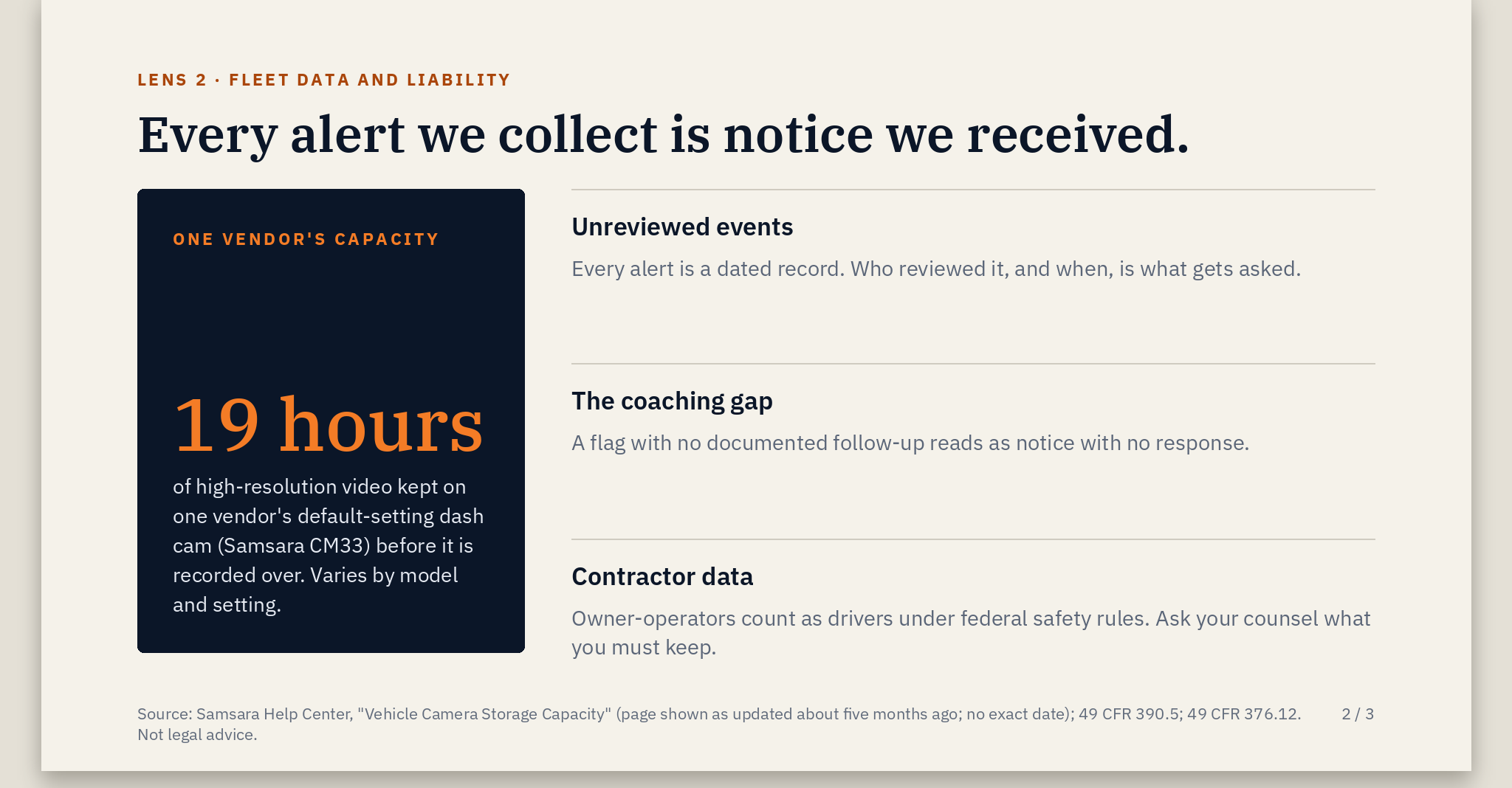
Your cameras and telematics flag risky driving all day. Every flag is a record with a date, a time and a severity. After a serious crash, a plaintiff's lawyer will ask what the company did about each one.
Defense lawyers say the same. In a Feb. 4, 2026 client alert, Amundsen Davis wrote that this data is "often requested pre-litigation, early in discovery, and used by claimants to argue notice, foreseeability, or negligent supervision." That is law-firm commentary, not a court holding.
Unreviewed events
A plaintiff-side lawyer, writing in the July 2026 Advocate, argues that the record of who reviewed an alert, when, and what they did can be "more valuable to a plaintiff than the video." His advice to colleagues: find who receives the AI safety alerts and depose that person. It is one advocate's opinion, written about California practice.
The same lawyer describes what a punitive-damages theory looks like: alerts for one driver over a meaningful window, then coaching records showing the alerts were "ignored or reviewed and dismissed without follow-up," then the same pattern across other drivers. The point is that a pattern reads as company practice, not one supervisor's lapse. Again, that is advocacy, not a ruling.
Footage has its own clock. Camera footage nobody saves is recorded over on a loop. Samsara's help center documents that a CM33 dash cam on its default setting keeps about 19 hours of high-resolution video on the device, with lower-quality secondary footage kept longer (104 hours). Capacity varies widely by camera model, video type and settings: the same page lists as little as 8 to 9 hours of high-resolution video on CM31 and CM33 with certain settings, 24 hours on the CM11 and CM12, and 40 on the CM22, and several hundred hours of lower-quality secondary footage with certain options. That is one vendor's documentation, and other vendors and settings differ. Check your own.
The coaching gap
A flag with no follow-up can read as "knew, and did nothing." Courts have not made it that simple.
- In Haines v. Brown (M.D. Pa., July 17, 2026), a punitive-damages claim survived summary judgment. The lack of a procedure for downloading post-accident telematics, despite having the capability, was one of several facts, alongside hiring, training and supervision evidence. The court called recklessness a jury question. It is not a verdict.
- In Thomas v. Orozco-Pineda (M.D. Pa., Sept. 30, 2025), plaintiffs argued thousands of speeding alerts were ignored. The court still granted summary judgment on punitive damages, because the speeding was not tied to the crash.
- In Holzendorf v. Star Van Systems (M.D. Fla., June 8, 2022), the court ordered driver-facing dash-cam video produced and noted the carrier apparently had not preserved the full video. That was a motion-to-compel order, not a sanction.
Neither of the first two cases turned on unreviewed alerts alone. The fair reading is that alerts get argued as notice, and a documented response is what a fleet can show.
Contractor data
Owner-operators do not sit outside the file.
- Federal safety rules count an independent-contractor driver as an "employee" while operating a commercial motor vehicle (49 CFR 390.5).
- Leases for owner-operator equipment must give the carrier "exclusive possession, control, and use" for the lease term (49 CFR 376.12(c)(1)).
- In Montgomery v. Caribe Transport II (May 14, 2026), a unanimous Supreme Court held federal law does not preempt state negligent-hiring claims against freight brokers. It did not say brokers must monitor continuously.
Courts also draw lines the other way. In De Leon v. Trahan (W.D. Tex., Aug. 28, 2024), a judge denied sanctions over telematics data (hours-of-service data) where the plaintiff waited more than six months to ask. That is one district judge's ruling and not a safe harbor. Ask your counsel.
Whether a duty to preserve reaches data on a contractor's own device is an open question. Ask your counsel.
The discovery test
If a plaintiff's lawyer asked tomorrow who reviewed this driver's alerts over the last twelve months and what was done about each one, could we answer in hours, not weeks?
Formal responses to document requests are generally due 30 days after the request is served (Fed. R. Civ. P. 34(b)(2)(A); state rules vary). The test is about whether you can answer, not about a deadline.
What we'd do now
- Name an owner for every alert type, and log who reviewed each event and when.
- Record what was done: coaching, a dismissal with a reason, or an escalation.
- Write down how long footage, alerts and coaching records are kept, and who can pause deletion.
- Have a post-crash procedure for pulling camera and telematics data.
- Bring contractor-held devices and data into that procedure. Ask your counsel what you must preserve.
- Run the discovery test on one driver this month.
- Ask your counsel how to structure post-incident reviews.
Captives and underwriters: ask insureds to show the review log, not just the alert settings.
General information, not legal advice. Items marked "ask your counsel" need review by your own lawyer.
Get The Weekly Beacon free: practical fleet safety and compliance signals, weekly. Subscribe at zorrorisk.com/weekly-beacon.
