
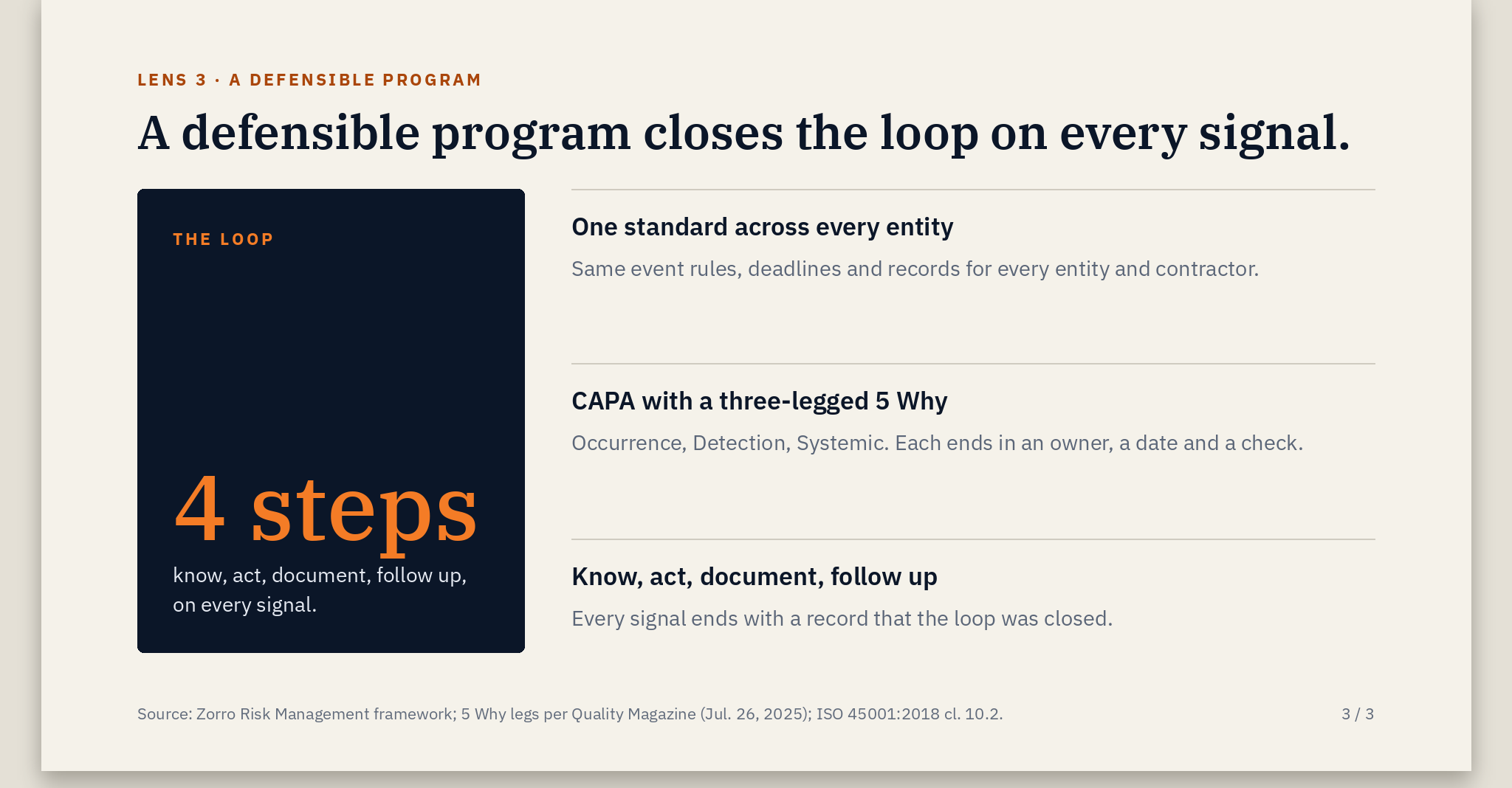
A defensible program closes the loop on every signal.
Every fleet collects signals: alerts, camera events, inspection findings, near misses, complaints, audit notes. The signal is not the hard part. What happens to it is. A defensible program can show, signal by signal, that the fleet knew, acted, wrote it down and went back to check. This post covers the three habits we build programs around.
One standard across every entity
Many fleets run more than one entity: separate USDOT numbers, separate terminals, separate contractor pools. Each entity may have its own habits for reviewing events, setting thresholds and keeping records. That is where gaps hide.
FMCSA already looks across entities in some contexts. Its rules define "reincarnated or affiliated motor carriers" as carriers with common ownership, common management, common control or common familial relationship (49 CFR 385.1003). That rule is about carriers hiding safety history, not about how you run your safety program. But it is a reminder that regulators can see the connections between your entities, and a plaintiff's lawyer may look for them too.
Our view: write one standard and apply it everywhere.
- The same event categories, review deadlines and escalation triggers for every entity.
- The same coaching and corrective-action rules for employees and contractors.
- The same record format, so any file can be pulled and read the same way.
Why it matters: an alert nobody reviews is still an alert your fleet received. If the same warning shows up three times and nothing changes, the record shows a pattern you did not close. A single standard makes it harder for that pattern to hide in one entity or one terminal.
CAPA with a three-legged 5 Why
CAPA means corrective and preventive action: fix what happened and stop it from happening again. ISO 45001:2018 (clause 10.2) expects an organization to react to an incident, evaluate the need for corrective action to remove root causes, review the effectiveness of what it did, and keep documented information as evidence.
The 5 Why method asks "why" repeatedly until you reach a cause you can act on. The three-legged version, runs three separate chains for the same event, as described in Quality Magazine (July 26, 2025):
- Occurrence: why did it happen?
- Detection (escape): why didn't we catch it earlier?
- Systemic: why did our management system allow it?
Here is how we translate that for fleets. This is our own framing, not part of the standard method: vehicle and driver factors sit inside the Occurrence leg. The Detection leg asks why an alert, inspection, camera event or audit did not surface the problem in time. The Systemic leg asks about policy, staffing, coaching capacity and oversight.
A quick fleet example, kept generic: a driver is involved in a rear-end event. The Occurrence chain might trace to following distance and a brake issue. The Detection chain asks why earlier hard-braking alerts never reached a reviewer. The Systemic chain asks why the coaching queue had no owner or deadline. Fixing only the first chain leaves the other two open.
Each leg ends in an action with an owner, a due date and a check that it worked.
Know, act, document, follow up
We use four steps for every signal:
- Know. Capture the signal and make sure someone reviews it.
- Act. Contain the risk, then correct the cause.
- Document. Record what was seen, decided and done, and by whom.
- Follow up. Check that the fix held, and close the file.
Data without a coaching loop is not enough. In December 2024 the NTSB recommended that a motor carrier use driver-monitoring technology fleet-wide, with policies and procedures for proactively using it for driver training and coaching (H-24-36, Dec. 19, 2024). It also found the carrier's safety practices inadequate for managing fatigue and crash risk.
Law-firm commentary points the same way. An Amundsen Davis alert (Sept. 4, 2026, Illinois) says plaintiffs increasingly pursue direct-negligence and punitive claims over hiring, training, supervision and safety practices, and that a documented culture of safety can undermine claims that a carrier consciously ignored known risks. That is one firm's commentary, not a court holding, and it does not promise any outcome in your case.
What we'd do now
- Pick one written standard for reviewing signals and apply it to every entity.
- Count your open signals: events, alerts and findings nobody has reviewed or closed.
- Run one recent event through all three legs: Occurrence, Detection, Systemic.
- Give every corrective action an owner, a due date and a follow-up check.
- Keep the record: what you knew, what you did, and what you checked afterward.
- Ask your counsel how to structure post-incident reviews.
This post is general information, not legal advice. Sources are linked in the text.
Get The Weekly Beacon free: practical fleet safety and compliance signals, weekly. Subscribe at zorrorisk.com/weekly-beacon.
