
The verdict turns on what we knew before the crash.
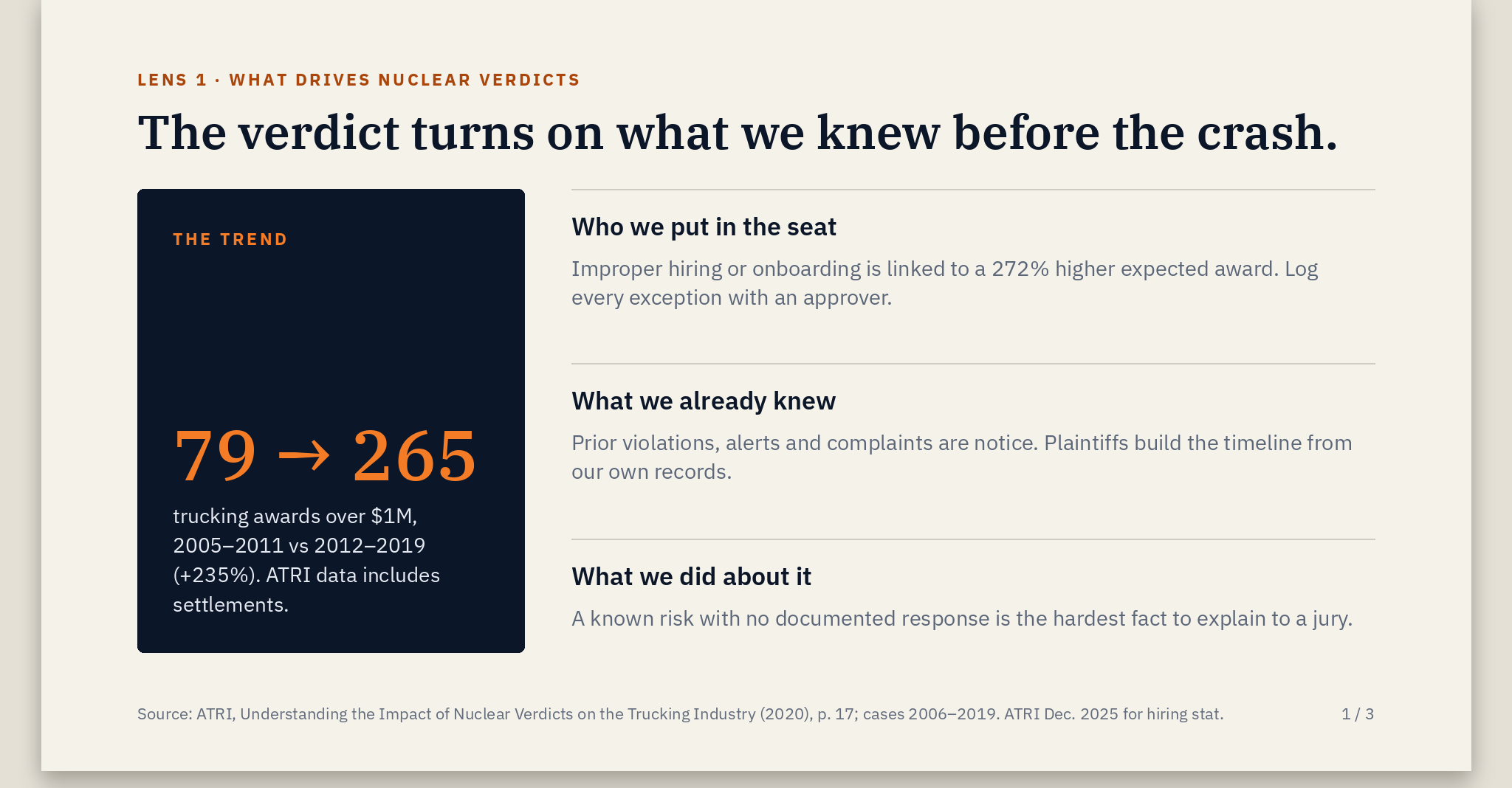
Plaintiffs in a serious trucking case rarely stop at the crash. They ask what the carrier knew before it, and what it did with that knowledge. Plaintiffs commonly frame the case around three questions: who you put in the seat, what you already knew, and what you did about it.
The numbers explain why this matters. ATRI's 2020 study of 600 trucking crash cases (2006 to 2019) counted 79 awards over $1 million in 2005 to 2011 and 265 in 2012 to 2019, an increase of 235%. Two cautions. ATRI's data includes settlements, not only verdicts. And a $1 million award is not what ATRI's 2025 report calls "nuclear": that term means $10 million or more. Marathon Strategies' 2026 report, as covered by Transport Topics on Sept. 23, 2026, counted 12 trucking and auto nuclear verdicts totaling $3.4 billion in 2025. Marathon's figures span industries and come from a communications firm, so treat them as a signal, not a forecast.
Who we put in the seat
ATRI's December 2025 study of cases concluded in 2019 to 2024 links improper hiring or onboarding to a 272.3% higher expected award, second only to substance abuse. In 33% of the cases alleging it, awards reached $10 million or more. ATRI also notes that in many of these cases the employer "had some level of prior knowledge and still proceeded negligently." Those figures describe ATRI's sample, not the odds for any one fleet.
- A written hiring standard only helps if exceptions to it are rare.
- An exception with no named approver and no stated reason reads as a decision to take the risk.
- Onboarding and training records belong in the driver file from day one.
What we already knew
In Denton v. Universal Am-Can, an Illinois appeals court affirmed a verdict of $19.2 million in compensatory damages plus $35 million in punitive damages. The record showed a driver whose file held prior accidents, violations, license suspensions and a felony conviction. A written policy called for rejecting him, a manager overrode it, and after hire the carrier never re-ran his motor vehicle record. He was dispatched while his license was suspended and had more policy points than the company's own cutoff allowed. The court's opinion lays out the facts.
In a Florida case, K&N Logging, FreightWaves reported a $141.5 million verdict after the defendants stipulated that the carrier knew or should have known the driver was unfit. That figure is as reported in the press.
The pattern: notice rarely arrives as one dramatic warning. It builds from records you already hold, such as violations, alerts, complaints and your own policy flags.
- Anything your systems recorded can be asked about later.
- A policy you wrote but did not follow becomes the plaintiff's yardstick.
- Re-checking drivers after hire matters as much as vetting them before.
What we did about it
ATRI's 2020 report, drawing on attorney interviews, says almost any failure to follow the FMCSRs or company safety policy becomes a focus of plaintiff arguments. It also says documented safety activity beyond the regulations "carries great weight with juries." We found no published figure tying specific coaching or discipline practices to award size, so we won't claim one. The point is qualitative: a known risk with no documented response is the hardest fact to explain.
- Every flagged event needs an owner, an action and a date.
- Coaching, discipline or removal from the seat should be recorded, not remembered.
- Follow up to confirm the behavior changed.
What we'd do now
- Write one driver-qualification standard and log every exception with an approver and a reason.
- Re-run motor vehicle records and review driver files on a set schedule, not only at hire.
- Pull every alert, violation and complaint on a driver into one timeline, and look at it before a plaintiff does.
- For each item on that timeline, record what was done and when.
- Captives and underwriters: ask insureds for the written standard and the exception log, not only the driver list.
This post is general information, not legal advice. Sources are linked in the text.
Get The Weekly Beacon free: practical fleet safety and compliance signals, weekly. Subscribe at zorrorisk.com/weekly-beacon.
